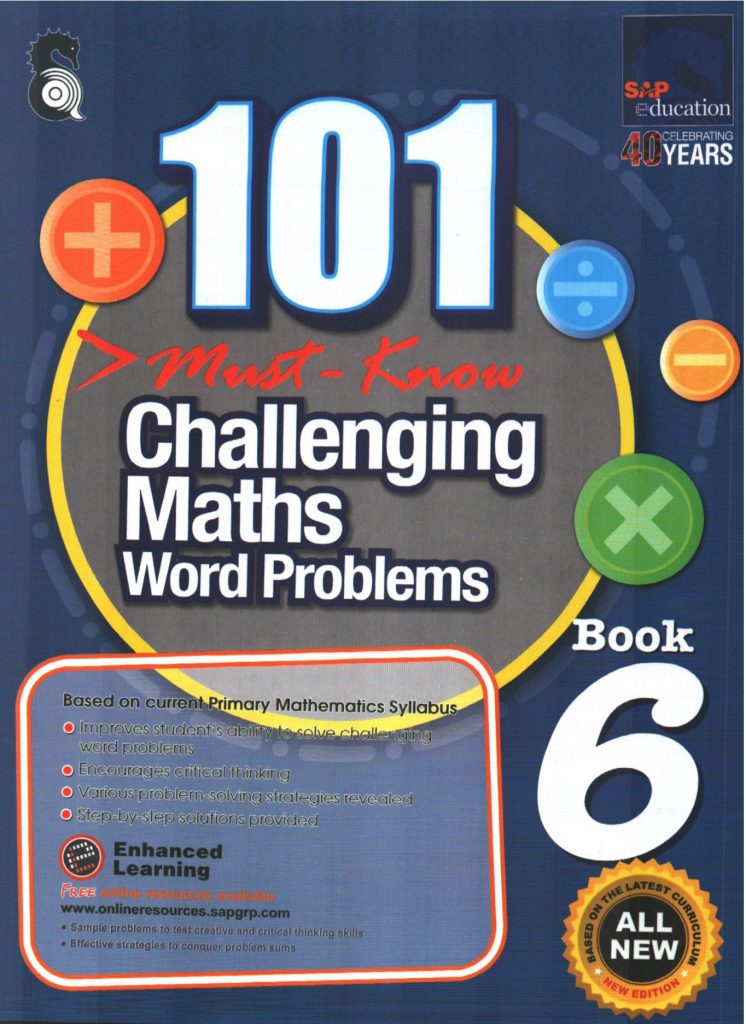
About This Book
101 Challenging Math’s Word Problems Book 6 is the sixth book of the 101 Challenging Math’s Word Problems series — a problem book in the series’ form: one hundred and one word problems (the count is the title’s own), no theory chapters, and the hardest brief the series sets at this level. As the second extension volume beyond the core run, it exists for one readership: pupils whose method is complete and whose teachers refuse to let completeness become boredom.
A capstone’s job is integration under pressure, and Book 6 integrates everything. The problems layer the series’ strategies the way real quantitative life layers them — a proportion embedded in a comparison, a remainder governing a chain, a condition that must be carried through four steps while surplus information argues for attention. Working must therefore be architectural: planned on paper, executed in labelled stages, and audited at the end by the solver’s own estimate. The volume also cultivates the social form of mastery — problems set to be solved in pairs, where two methods collide and the better one wins on evidence — because secondary classrooms reward pupils who can defend a route, not merely reach an answer. Nothing in the book exceeds the primary toolkit; everything in it exceeds the primary comfort zone, deliberately and by design. A pupil who finishes Book 6 has done something quietly remarkable: they have completed six hundred and six problems’ worth of training in reading the world quantitatively — and the habit, by now, is simply how they think.
What Learners Will Practise
Layered Problem Solving
Children practise problems whose solutions stack strategies: proportion inside comparison, conditions inside chains, estimation governing the whole. Integration is the skill — choosing not one tool but a sequence, and keeping the sequence coherent across a page of working.
Argument in Pairs
The problems practise mathematical disagreement conducted properly: two solvers, two routes, one verdict reached by evidence. Pupils learn to critique a method without criticising its author — the seminar skill, learned six years early and never unlearned.
Independent Completion
Pupils practise finishing hard things alone: unhinted problems, sustained working, self-audit by estimate and check. The volume is designed to be completable without rescue, and the confidence that completion confers is its real certificate.
Key Features
The capstone integration is the feature: every strategy the series owns, demanded in combination, at full stretch. The pair-argument design is the second — mastery practised socially — and the honest difficulty the third, a final volume that respects its readers by refusing to flatter them. In this collection it is the word-problem shelf’s sixth book.
Who This Book Is For
The series’ most senior primary pupils are its first audience — completers of the earlier volumes with appetite intact. Teachers form its second readership, handed a summit text that keeps a top set honest. Parents make its third, watching pair arguments about method at the kitchen table and recognising, with some awe, a young mathematician in residence.
How to Use This Book
Deploy it as a capstone, not a workbook: selected problems, generous time, discussion guaranteed. Pair solvers deliberately — comparable strength, different instincts — and make the verdict conversation the lesson’s centre. Close the volume as the series deserves: with the class’s hardest problem attempted publicly, by volunteers, to applause for the attempt as much as the answer.
Related Books
The word-problem shelf’s fifth book stands at 101 Challenging Math’s Word Problems Book 5, and the vocabulary shelf’s eighth book waits at Building Vocabulary Book 8.