About This Book
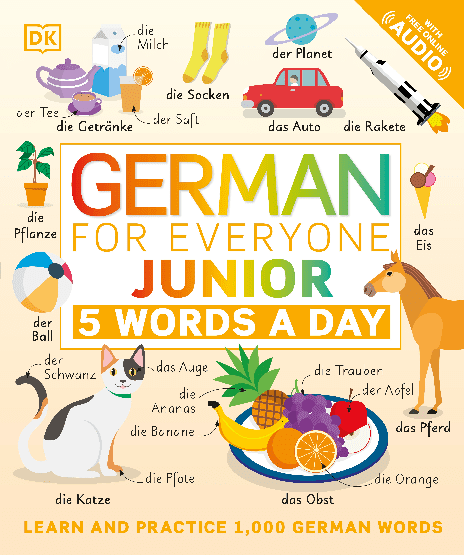
German for Everyone Junior, 5 Words a Day is a vocabulary book for young learners organised around its title’s daily ration: five words a day. The design is a wager about how children actually acquire language — not in weekend floods but in daily sips, each day’s five words small enough to be fully met, played with and kept, rather than glimpsed and lost in a crowd of fifty.
The junior address shapes everything the ration implies. Five words for a child are five things: named, pictured in the mind, usable by supper. The book’s arithmetic is its quiet argument to the adults around the child — that consistency outperforms intensity at this age, and that a habit a child enjoys will out-teach a programme a child endures. ‘For Everyone’ is the series’ democratic promise applied at the starting gate: the first German a child meets should feel like an invitation, because the feeling of the first hundred words decides whether there will be a second hundred.
What Learners Will Practise
Five Words, Fully Met
Children practise depth over breadth: each day’s five words learned properly — heard, said, recognised, used — instead of twenty words half-met and wholly forgotten. The practise builds the experience of complete small victories, which is the emotional fuel young learners run on.
The Daily Habit Itself
The book trains routine as a skill: same small appointment, every day, kept. Young learners practise showing up for German the way they show up for breakfast — without negotiation or dread — and the habit, once installed, carries vocabulary growth the way a conveyor carries anything: unglamorously and completely.
Words From a Child’s World
Learners practise the vocabulary of their own lives first — the animals, foods, colours, family and weather of a child’s day — because words that name the visible world get used, and used words are the ones that stay. The child’s German grows outward from what they can point at.
Key Features
The daily ration is the feature: five words a day, a promise a child can keep and a parent can supervise. The junior design is the second — vocabulary chosen from a child’s world rather than an adult syllabus shrunk — and the accumulation the third, hundreds of words a year arriving without a single overwhelming day. In this collection it is the German shelf’s tortoise: the book that wins by never asking too much.
Who This Book Is For
Young learners are its first readers — children meeting German early, at home or in first classes. Their parents form its second readership, given a programme whose daily ask they can actually sustain. Early-years teachers make its third: five words a day is a classroom ritual as readily as a kitchen-table one.
How to Use This Book
Keep the appointment sacred and short: five words, every day, at a predictable moment, and stop while it is still fun. Say the words aloud together, pin them to the real objects they name around the house, and let yesterday’s five ambush the child in today’s sentences. Resist doubling up after missed days — the ration’s smallness is the method, and a debt of twenty words teaches only avoidance. Mark the growing total somewhere visible; children, like adults, are motivated by a number that climbs.
Related Books
Stories carry the same young audience further at Learn German German for Kids–Bilingual Stories in English and German, and a first picture dictionary for small learners waits at Mein erstes Bildwörterbuch.